
How Much Climbing Is That? Famous Cycling Climbs by D+
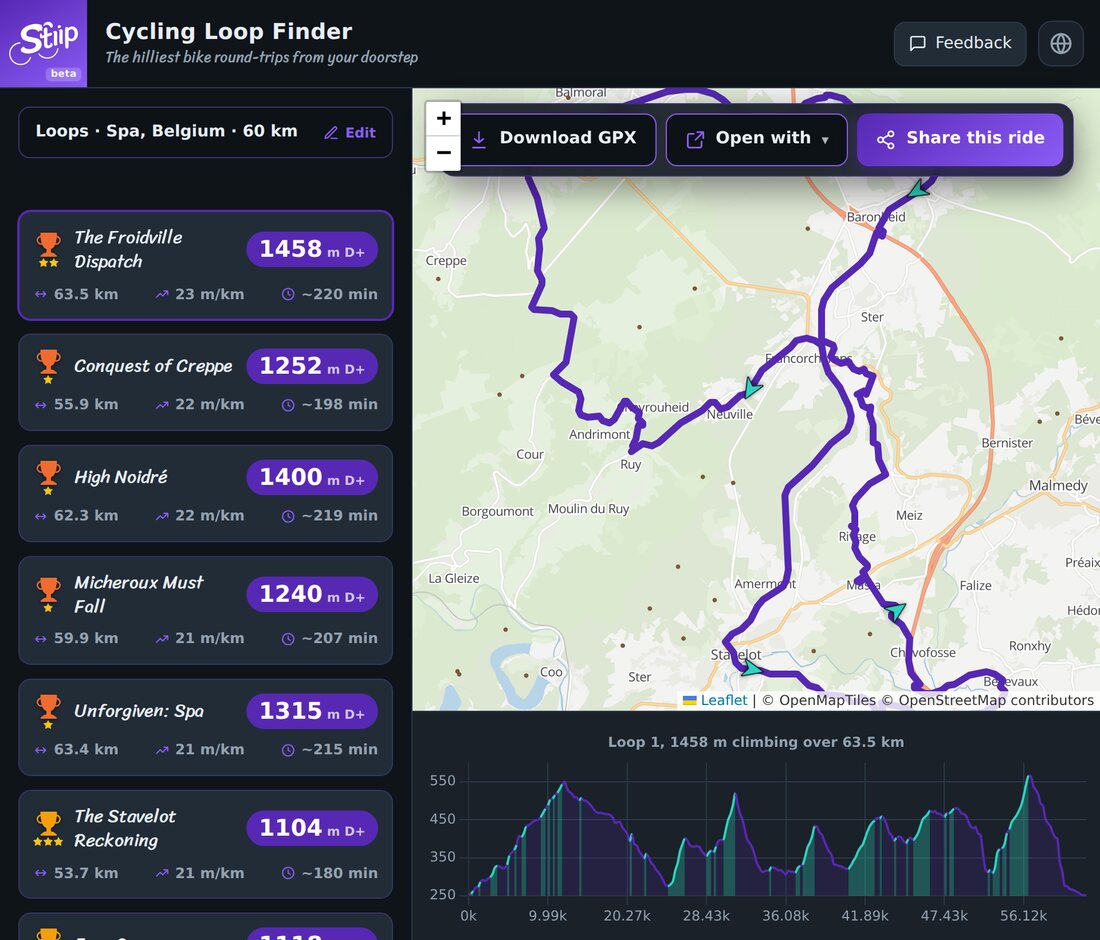
Stiip tells you a ride is "1,200 m D+." But what does that actually feel like? Here's a scale of famous climbs by their elevation gain, so you can picture it. (Numbers are approximate and depend on which side you climb.)
The climbing scale
- ~65 m, the Koppenberg (Flanders). Short, cobbled, brutally steep. A classic "wall."
- ~130 m, the Mur de Huy (Belgium). The ramp that decides Flèche Wallonne.
- ~165 m, La Redoute (Ardennes). The iconic climb of Liège-Bastogne-Liège.
- ~540 m, Mont Faron (near Toulon). A proper coastal climb with a view.
- ~670 m, Sa Calobra (Mallorca). The famous snake of hairpins.
- ~1,120 m, Alpe d'Huez (Alps). 21 legendary hairpins.
- ~1,210 m, Col du Galibier from Valloire (Alps). A giant of the Tour.
- ~1,300 m, Passo del Mortirolo (Italy). One of the hardest climbs in the Giro.
- ~1,610 m, Mont Ventoux from Bédoin. The Giant of Provence.
- ~1,840 m, Passo dello Stelvio from Prato. 48 hairpins, near the roof of the Alps.
So what does your ride add up to?
A rolling 60 km loop at 1,000 m D+ is basically an Alpe d'Huez worth of climbing, spread over the day, right from your doorstep. A big hilly day at 1,600 m? That's a Mont Ventoux.
You don't need the Alps to bank serious climbing. Stitch enough local hills together and the meters add up fast. (New to the number? Here's what D+ actually means.)
Build a loop and see how many "famous climbs" it's worth.