How to Plan a Hilly Cycling Route With a Target Elevation Gain
Most riders plan a ride by distance: "I'll do 80 km today." But if you want to get stronger on the climbs — or just enjoy the best roads in your region — the number that really shapes a ride isn't distance, it's elevation gain, the total metres you climb over the route (often written D+). Two 80 km loops can be worlds apart: one rolling river-valley spin at 400 m of climbing, one leg-shredding 1,600 m day in the hills. This guide walks through planning a route around a D+ target instead of a distance target.
Why elevation gain matters more than distance
Distance tells you how long you'll be out. Elevation gain tells you how hard the ride will be and what it trains. Climbing is where you build sustained power, where races and hard group rides are won or lost, and where the scenery is usually best. If your goal is to ride the Ardennes classics, tackle an Alpine col, or simply stop dreading the hills near home, you need to plan rides that actually contain climbing — not hope you stumble into it.
The most useful single metric is D+ per kilometre (total elevation gain ÷ distance). It captures how relentlessly hilly a route is, independent of length:
- Under 6 m/km — flat to gently rolling. Recovery rides, fast flat efforts.
- 6–10 m/km — rolling. Noticeable hills, still plenty of tempo between them.
- 10–15 m/km — genuinely hilly. Punchy climbs come thick and fast.
- 15 m/km and up — mountainous. Long sustained climbs or wall-to-wall short ramps.
For reference, a hard day in the Belgian Ardennes often lands around 12–15 m/km, while a big Alpine stage with two or three long passes can sit near or above 20 m/km.
Choosing a realistic D+ target
Start from where you are, not where you want to be. A good rule of thumb: your target for a normal training ride is roughly your recent typical ride's climbing plus about 10–15%. Chasing a huge jump in one go usually means blowing up halfway and walking a climb — which builds neither fitness nor confidence.
Think in terms of the whole ride:
- Building base or coming back from a break: aim for 6–8 m/km. Enough to feel the terrain without shredding your legs.
- Solid, climbing-focused training day: 10–13 m/km. This is the sweet spot for most riders wanting to improve.
- Peak/event simulation: 15+ m/km, and match the shape of your goal event — long steady passes vs. short repeated punches train different things.
Also decide whether you want one big climb or many short ones. A single long col teaches pacing and steady threshold effort; a route stitched from a dozen short ramps trains repeatability and recovery between surges. Both are useful; pick the one that matches your goal for the day.
Building the loop
Once you have a distance window and a D+ target, you need roads that deliver the climbing without dead ends, motorways, or endless flat connectors. Doing this by hand on a map is slow and frustrating — you drag a route, check the elevation, realise it's too flat, and start over.
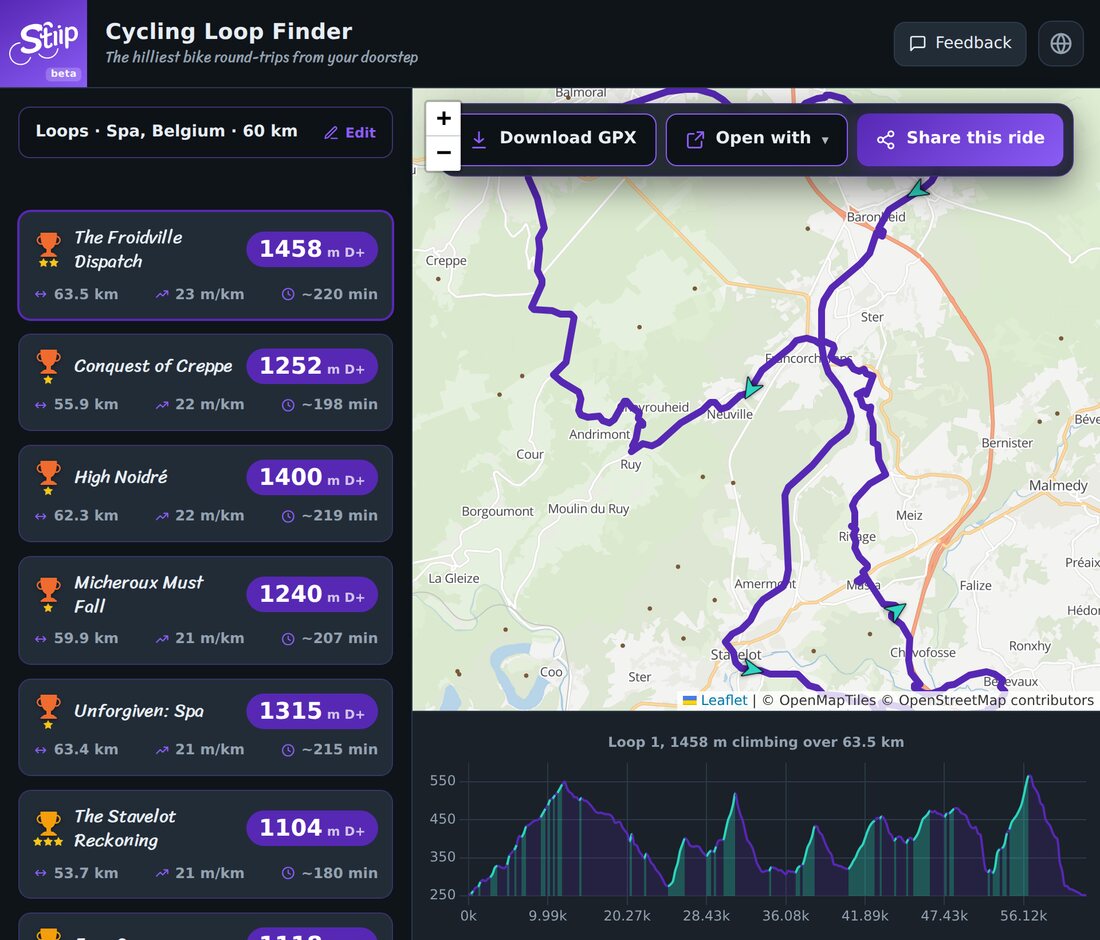
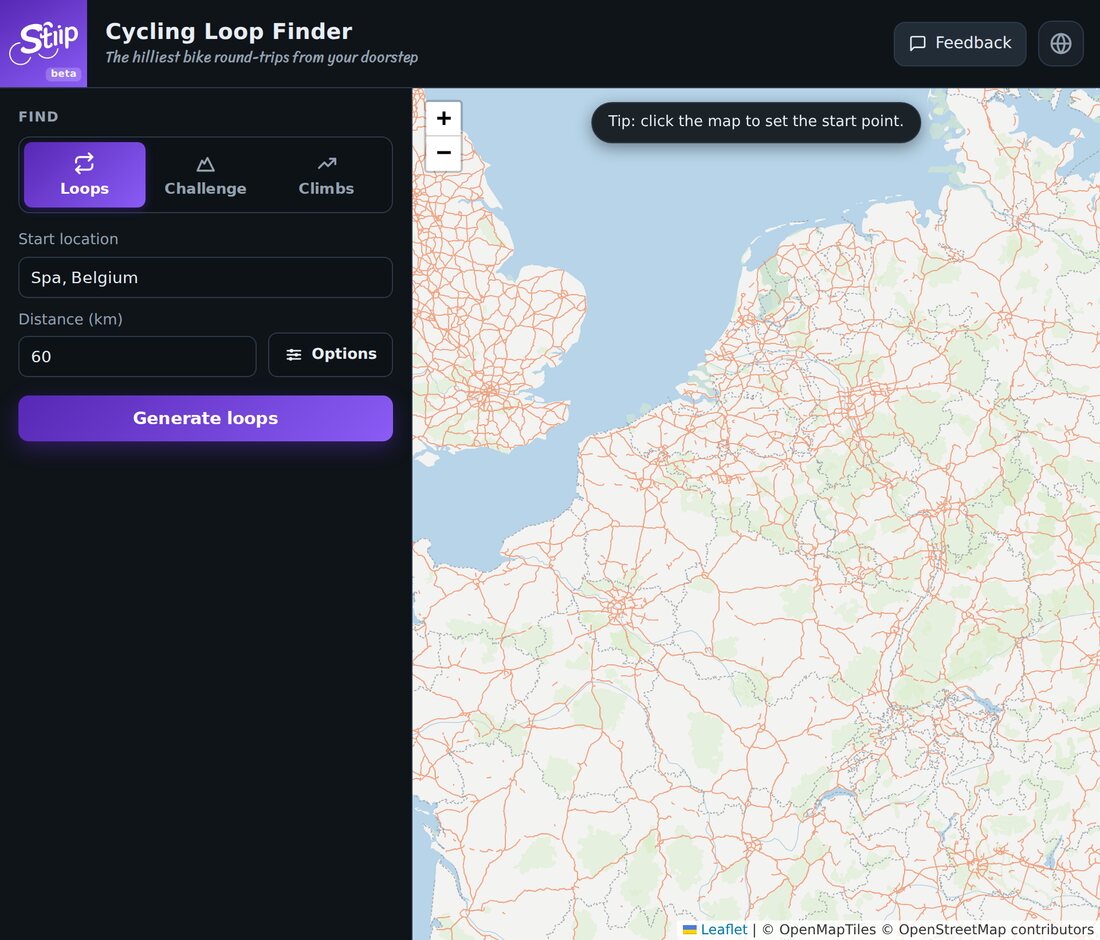
This is exactly what Stiip's loop builder is for: drop a start point, set your distance, and it returns the hilliest loops that fit, ranked by total ascent, already routed over climbing-friendly roads and back to your door. You pick the one whose profile you like, then export the GPX to your Garmin, Wahoo, or head unit. Instead of forcing hills into a route, you start from the hilliest option and adjust down if it's too much.
If you'd rather build a ride around a specific climb — a local wall you want to train on, or a famous col — start from the climb instead. The climb finder scouts the biggest climbs in a radius around any point, so you can see what's actually near you, pick one, and build the day around it.
Reading the profile before you ride
Before you commit, look at the elevation profile, not just the total. The same 1,200 m of D+ feels completely different depending on how it's distributed:
- Front-loaded climbing means you hit the hard part fresh — good for a hard day, but respect the return leg.
- Back-loaded climbing (the sting in the tail) is the most common way to get caught out; save something for it.
- Evenly rolling rarely lets you settle into a rhythm, which is tiring in its own way.
Note the gradient of the steepest sections too. A 6% average climb is a steady effort; ramps of 12%+ will force you out of the saddle and can wreck your pacing if you didn't plan for them.
Pacing and gearing
Two practical tips turn a well-planned hilly route into a good ride:
Pace off the whole route, not the first climb. It's tempting to attack the opening hill; the riders who feel strong at the end are the ones who climbed the first one a gear easier than felt necessary. If your route is back-loaded, this matters even more.
Gear for the steepest ramp, not the average. Check the max gradient on your profile and make sure you have a low enough gear to spin it at a cadence you can hold — ideally 70+ rpm — without grinding. For genuinely steep or long climbs, a 34-tooth (or smaller) chainring paired with a wide cassette (say, up to 32 or 34 in the rear) saves your knees and keeps you seated and efficient.
Turn it into a habit
The riders who improve most on hills aren't doing heroic one-offs — they're consistently planning rides that contain the right amount of climbing, week after week. Set a D+ target, generate a loop that hits it, ride it, and nudge the target up as it gets easier. Over a season, that steady progression does more than any single epic day.
Ready to plan your next one? Build a hilly loop from your doorstep or find the biggest climbs near you — both are free, no account needed.